News

Q & A – Do I need planning permission to install air conditioning?

Planning Permission is very commonly required for the installation of air conditioning equipment but, due to the infinite variety of specific circumstances, the best advice is always to discuss your proposals with the relevant Local Planning Authority and Building Control Service before starting work.

For more information please read about Air Conditioning regulations.
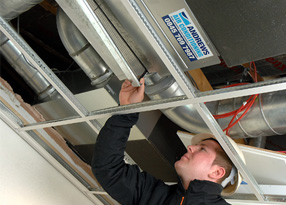
Q & A – Will Andrews Air Conditioning be able to maintain or repair a system which you didn’t install?

Yes. Andrews Air Conditioning are experts in the maintenance and repair of all types of air conditioning and we commonly take over the maintenance of air conditioning which has been in place for some time. During our initial maintenance visit we will assess the performance of your air conditioning and make recommendations for any repairs or replacements which are necessary in order to bring the system up to the required standard for an ongoing maintenance contract.

For more information please visit our Air Conditioning Maintenance page read more

Q & A – My air conditioning came with a manufacturer’s warranty so why do I need a maintenance contract?

Manufacturers’ warranties are always dependent upon the equipment having been used in accordance with their recommendations and having been maintained according to their specifications. It is similar to a car manufacturer’s requirements that a user ensures routine servicing is carried out during any warranty period. A Planned Maintenance Contract from a manufacturer-accredited service provider ensures manufacturer’s warranties remain valid and can often be extended to cover several years.

For more information please visit our Air Conditioning Maintenance page read more

Q & A – What is F-Gas?

F-Gas is a term used to describe any of a range of fluorinated gases such as CFCs, HFCs and HCFCs which are, or have been in the past, widely used in refrigeration-related applications such as air conditioning. Some F-gases are ozone-depleting whilst others are known to contribute to the greenhouse effect and global warming.

The F-Gas Regulations are EU legislation designed to strictly limit the release of F-gases into the atmosphere. By law, all air conditioning systems containing over 3kg of F-Gas refrigerant must be checked for damage and leaks at least once per year by an F-Gas certified contractor. Andrews Air Conditioning Services holds F-Gas certification accredited by REFCOM and approved by DEFRA and our annual F-gas checks and certification can be incorporated into one of our Planned Maintenance Contracts. read more

Planning Ahead for R22 Replacement

Why should owners of air conditioning using R22 refrigerant consider replacing it?

Any air conditioning over 10 years old probably uses R22 refrigerant, an ozone-depleting CFC which was banned in most new systems in 2002. By EU law R22 systems will become unserviceable at the end of 2014, meaning that it will be illegal to repair them in the event of any failure. It is not economical to repair the systems as spare parts and recycled R22 are expensive and in short supply.

Modern replacement systems use more environmentally friendly refrigerants and are up to 60% more energy efficient than R22 systems, meaning that owners often pay back replacement costs in energy savings alone within 3 or 4 years. read more

Q & A: What is R22?

R22 is the name of a commonly used CFC refrigerant which has been banned in new air conditioning systems in UK & Europe since 2002 because of its ozone-depleting properties. Therefore although many are still in use, these ageing systems will, by law, become unserviceable at the end of 2014. At that point it will be illegal to repair them in the event of any failure. Spare parts and recycled R22 are already in short supply and increasingly expensive so, even now, it is often uneconomical to attempt a repair. Furthermore, modern replacement systems use environmentally responsible refrigerants and are up to 60% more energy efficient than R22 systems, meaning that they often pay back their replacement costs in energy savings alone within 3 or 4 years. read more

Q & A: How often should air conditioning be maintained?

The frequency of maintenance depends on the usage pattern of the air conditioning and the environment in which it operates. Generally equipment which runs for long periods of the day, is used for both winter heating and summer cooling or operates in a dirty or dusty environment should be visited at least twice per year and often 4 or more times per year. Planned Maintenance Contracts are specifically tailored to suit your particular environment and installation with the frequency of visits set to ensure the optimum reliability and efficiency of the air conditioning. read more

Q & A: How much does air conditioning cost to run?

The costs will vary depending on the size of your air conditioning installation, the cooling or heating load and the length of time you operate your air conditioning for. However a typical 3.5kW air conditioner operated on a normal office usage profile will use only around 75p of electricity per day.

For more information please read cutting business costs with air conditioning.

Q & A: Can air conditioning be used for heating as well as cooling?

Can air conditioning be used for heating as well as cooling? Yes, with heat-pump technology modern air conditioning systems are capable of providing room heating as well as cooling. Some of the more sophisticated systems are able to cool some areas whilst recovering and redistributing the energy to simultaneously heat others. Even in winter heat energy is harvested from the outside air, providing a highly effective, controllable and economical alternative to other types of heating.

Read more about the benefits of new air conditioning installation read more

Do You Know Your R22 From Your Elbow?

If your air conditioning is over 10 years old, it’s likely to use the ozone-depleting R22 refrigerant. By law, these systems will become unserviceable at the end of 2014. So maybe you feel there is plenty of time to think about it?

It may seem that way but the deadline is less than two years away and things can change very quickly – just two years ago Colonel Gaddafi was still in firm control of Libya, Steve Jobs was still running Apple Inc. and the Fukushima Nuclear Plant in Japan was over a month away from being struck by a disastrous tidal wave. read more